

Registered apprenticeships are the largest and most recognized public-private apprenticeship program in the U.S. For almost 90-years, they have created new options for career pathways and provided debt-free job training for workers. Registered apprenticeships have also been beneficial for businesses and the economy at-large, representing a source of needed workers with contextualized skills and facilitating greater U.S. economic growth.
Any legal worker in the U.S. meeting the basic requirements is eligible for the registered apprenticeship program, U.S. citizens and work-authorized immigrants alike. This explainer provides some history on U.S. registered apprenticeships, including the benefits of registered apprenticeships and the role of immigrants in the program.
Why Apprenticeships?
Apprenticeships, broadly defined, are an opportunity to learn a particular skill with a combination of paid hands-on-work and training, be that formal classroom training or on the job training that varies in duration and format. They represent opportunities to secure skills needed for longer-term employment in a specific job sector. The general definition for apprenticeships allows for any number of variations in how apprenticeships are structured, the understanding between the apprentice and mentor or industry/sponsor, and the outcomes. Apprenticeships of one kind or another have existed in the U.S. since its founding.
The U.S. Department of Labor (DOL) more precisely defines registered apprenticeship as “an industry-driven, high-quality career pathway where employers can develop and prepare their future workforce, and individuals can obtain paid work experience with a mentor, receive progressive wage increases, classroom instruction, and a portable, nationally-recognized credential.” Registered apprenticeship programs vary in duration from 1 to 4 years. A registered apprenticeship program has very well-defined requirements with five core elements: industry lead, paid employment, structured on the job learning (OJL), supplemental education, and national credentials.
The benefits of registered apprenticeships to those entering the workforce are numerous, including an opportunity to learn a trade or skill as an alternative to a two- or four-year college, without the accompanying tuition. While learning, an individual in a registered apprenticeship is paid and does not acquire student loan debt. Alternatively, a registered apprenticeship can also be the first step in a pathway that leads to higher education.
Registered apprenticeships provide portable and nationally-recognized credential(s), making it possible for apprentices to look for similar work almost anywhere in the U.S. It is an opportunity for individuals to experience work in a particular sector before determining their ultimate career path. In addition to new workers entering the job market, apprenticeships hold enormous potential for incumbent workers looking for upward mobility or a new job, as well as for workers who are displaced by automation, AI, or other factors. As of fiscal year (FY) 2023, annual salaries of those who had completed a registered apprenticeship program were about $80,000.
Recent Developments
The benefits and great potential apprenticeships hold for many is linked to understanding both the historic and current U.S higher education and job market context. Recent developments shed light on how apprenticeships present opportunities for more workers, citizens, and immigrants alike.
The COVID-19 pandemic initiated a nearly 8% nationwide drop in college enrollment from 2019-22, with the percentage of high school graduates ages 16-22 enrolling in colleges and universities falling from 66.2% in October 2019 to 62.8% in October 2024. That decline in college enrollment has yet to fully rebound and it is unclear if it ever will.
Almost two-thirds of graduates with bachelor’s degrees have student loan debt, borrowing nearly $35,639 in education loans on average. Similarly, average student loan debt at graduation, adjusted for inflation, has grown by 41% since 2007. The underemployment rate for recent college graduates (employment in jobs that typically do not require a bachelor’s degree) was 41.5% as of March 2026, and fewer than one-in-five U.S. job postings (17.8%) currently require at least a college degree. Given these current realities, alternatives to a traditional 2- to 4-year college education are likely to appeal to current and future members of the workforce.
Immigrants and Apprenticeships
As noted above, work-authorized immigrants are eligible for registered apprenticeships. Immigrants are heavily represented in sectors with high levels of apprenticeships such as construction, the skilled trades, healthcare, early childhood education, and manufacturing.
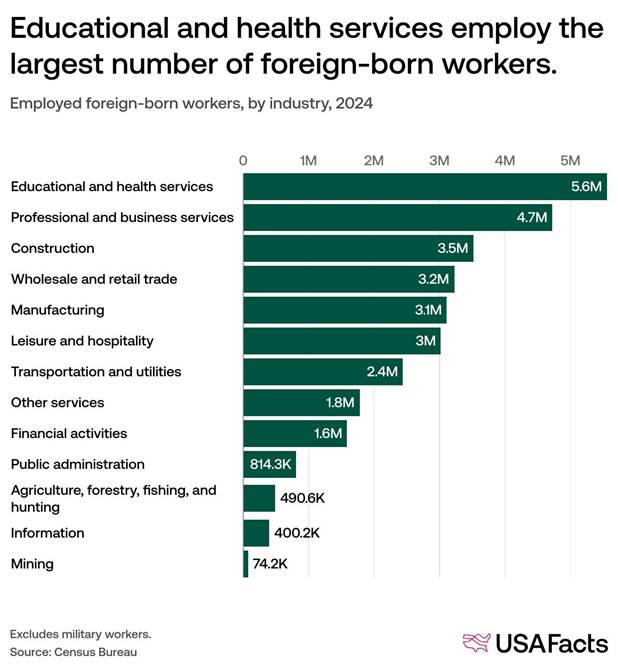
Source: USAFacts
Researchers have examined how apprenticeship programs could be leveraged to encourage more immigrants to enter sectors facing labor shortages, such as the early childhood education and care (ECEC) sector. This sector’s workforce, which faced major shortfalls following the COVID-19 pandemic, is already about 20% foreign born. Creating more ECEC apprenticeships could potentially draw more workers into this field.
Construction is another sector that could benefit from additional immigrant-facing apprenticeships. Immigrants are heavily represented in the sector, comprising 25% of construction workers. Notably, the construction industry has the highest percentage of apprenticeships, representing nearly 36% of all apprenticeships.
Registered apprenticeships can serve as a promising alternative for immigrant workers. Many first-generation immigrants’ family and living situations require that they prioritize working and earning money to support their families rather than pursuing higher education. In such circumstances, apprenticeships can help them develop skills and advance their careers as they earn a living.
Unfortunately, the U.S. government does not track the number of immigrants in apprenticeship programs and detailed information on immigrant enrollment in apprenticeship programs is limited. However, even though sector-specific data on immigrant participation in registered apprenticeships is limited, the benefits of these programs to these communities is clear-cut, considering the benefits to the broader workforce. Given work authorized immigrants’ eligibility for apprenticeships, expanding registered apprenticeships in key sectors will benefit both native born workers and immigrant workers.
What apprenticeship programs are federally recognized in the U.S.?
Federally recognized apprenticeship programs in the U.S. can be characterized as either (1) “registered apprenticeships,” (2) “industry recognized” apprenticeships, or (3) pre-apprenticeships.
Traditionally, “registered apprenticeships,” which carry nationally-recognized credentials, have tended to be the focus of federal policymakers and administrators. DOL maintains an established application process to recognize registered apprenticeship programs.
Breaking from the historical federal focus on registered apprenticeships, the first Trump administration took steps to promote unregistered or “industry-recognized apprenticeships.” Unregistered or industry-recognized apprenticeships are programs where “employers are individually able to set wages, hourly requirements for hands-on and related instruction, and the ratio of professionals to apprentices.” While they may lack the highly structured standardization and government vetting of registered apprenticeships, they provide greater program flexibility to businesses, reducing bureaucracy and administrative compliance costs. Industry-recognized apprenticeships provide flexibility, allowing employers to tailor apprenticeship programs such that they could more easily expand into other sectors. While trade group or specific industry apprenticeships date back to the Middle Ages, industry-recognized apprenticeships, which are not fully accounted for in the U.S., were only first officially promoted by the federal government in an executive order in 2017. This formal framework for unregistered apprenticeships was short lived and rescinded in early 2021 by the Biden administration, at which time there were only about 130 official industry-recognized apprenticeship programs in the U.S. As of the time of publication, the second Trump administration has yet to reemphasize these programs and seems to instead be devoted to promoting registered apprenticeships. While these industry recognized apprenticeships raised some concerns, including competing for funding with registered apprenticeships and limited quality controls, they were an attempt to officially provide additional opportunities for apprenticeships with greater flexibility to businesses.
What is the history of apprenticeships in the U.S.?
The first recorded registered apprenticeship programs in the U.S. were created in Wisconsin in 1911. The program came about through the passage of the Wisconsin Apprenticeship Law, which created a formal, state-supervised system of apprenticeships, and later served as a model for other states and eventually the federal government. This state apprenticeship program created safeguards for apprentices and employers and was an “earn-while-you-learn” program. Even today within the registered apprenticeship program there is a distinction between the Department of Labor’s Office of Apprenticeship (OA) and recognized State Apprenticeship Agencies (SAA).
In 1937, during the Great Depression, President Franklin D. Roosevelt signed the National Apprenticeship Act, which was sponsored by Rep. William J. Fitzgerald (D-Connecticut), a former labor official. The National Apprenticeship Act sought to advance skilled labor and protect workers by establishing standardization in apprenticeships in support of the ongoing economic recovery. Under the legislation, which garnered broad labor movement support, Congress established basic training requirements and worker protections for registered apprenticeship programs. The National Apprenticeship Act also established apprenticeship certifications that were recognized nationwide, resembling the portability of an associate or bachelor’s degree.
By the mid-1940’s, the federal registered apprenticeship program had about 4,000 apprentices. By 1949, during the post-WWII economic boom, the program had grown exponentially, with 230,000 apprentices participating. Many of the new apprentices were veterans, including many accessing the program through the GI Bill, and military apprenticeships continue to be an important part of registered apprenticeships through the United States Military Apprenticeship Program (USMAP).
This number of 230,000 apprentices was a high-water mark for workforce representation comprising 0.37 % of the U.S. workforce in 1949. Over the next thirty years, from 1949- 1979, the total number of apprentices grew much slower than the overall workforce, with 290,000 apprentices comprising 0.28% of the workforce in 1979. This trend continued for the next three-decades, with the percentage failing to 0.22% of the workforce in 2011.
Subsequent efforts by the Obama, Biden, and Trump II administrations to promote alternative career paths for U.S. workers have reversed this trend. Since 2015, across multiple administrations, registered apprenticeship programs almost doubled in size, going from more than 359,000 in 2015 to more than 678,000 apprentices in 2025, representing approximately 0.40% of the workforce by 2025, exceeding 1949 levels.
Building on that progress, in April 2025, President Trump issued an executive order that would include establishing “a plan to reach and surpass 1 million new active apprentices.” The plan would be developed within 120 days of the order date by the Secretaries of Labor, Commerce, and Education. Although the path to achieve this target remains unclear as no public plan has yet been released despite the deadline in the executive order. However, the initial steps in funding new apprenticeships have been encouraging. In June 2025 DOL announced $84 million in federal grants available nationwide to expand registered apprenticeships. In September 2025, DOL announced partnerships with Alabama and Colorado to expand registered apprenticeships, including $12.5 million in grant funding to each state toward that goal. In April of 2026, the Department of Labor announced that it would make available $85 million in federal grants nationwide to expand registered apprenticeships. In the FY2026 budget request, DOL’s budget-in-brief proposed a new initiative called “Make America Skilled Again” (MASA) that would be funded at nearly $3 billion. The budget request would allocate 10% of that funding towards registered apprenticeship activities.
Over the past decade, Congress has increasingly prioritized registered apprenticeships, by increasing funding levels from $90 million in FY2016 to $285 million in FY2024. While increased federal appropriations for apprenticeships has helped facilitate the growth of the program (providing new opportunities for U.S. citizens and immigrants alike), further resources and activities will be needed to reach the Trump administration’s goal of “1 million new active apprentices.”
Appropriated Funds for Apprenticeship Expansion,
FY2016-FY2024
| Fiscal Year | Funding Level ($ in millions) | Public Law |
| 2016 | $90 | P.L. 114-113 |
| 2017 | $95 | P.L. 115-31 |
| 2018 | $145 | P.L. 115-141 |
| 2019 | $160 | P.L. 115-245 |
| 2020 | $175 | P.L. 116-94 |
| 2021 | $185 | P.L. 116-260 |
| 2022 | $235 | P.L. 117-103 |
| 2023 | $285 | P.L. 117-128 |
| 2024 | $285 | P.L. 118-47 |
Source: CRS
How do registered apprenticeships in the U.S. compare with apprenticeship programs in other countries?
In comparing the U.S. registered apprenticeship program with apprenticeship programs in other countries, the program is relatively underutilized in the U.S. Other countries, which are members of The Organisation for Economic Co-operation and Development (OECD), have a much larger percentage of their workforces in apprenticeship programs, with some smaller countries even exceeding the U.S. in total apprenticeships.
In 2025, there were almost 700,000 apprenticeships in the U.S., making up about 0.4% of the U.S. workforce. By comparison, in Germany, with less than a quarter of the population of the U.S., there were about 1.2 million apprenticeships in 2023. In Switzerland, nearly 65% of young people pursue apprenticeships, compared to about 2% of young adults in the U.S.
Several studies have examined why the prevalence of apprenticeships varies so much between the U.S. and Switzerland. Historic, cultural, and educational differences play a large role, notably the U.S.’s focus on higher education pathways for graduating high school students, versus Switzerland’s longstanding preference for vocational training.
In Switzerland, students are split into two tracks at as early as 15 years of age. Approximately one-third of students are placed on a university track, and the remaining two-thirds are placed on vocational training and apprenticeship track. In Switzerland, employers play an integral role in designing apprenticeship programs, including curricula and program standards. Young workers in Switzerland have experienced benefits correlated with the higher uptake on apprenticeships, including lower youth unemployment (less than 3% in Switzerland versus more than 10% in the U.S.) and good wages.
A similar situation arises in the United Kingdom. Even though the U.S. population is approximately five times the size of the U.K., the U.K. has more apprenticeships, (approximately 760,000 versus 700,000).
Comparing the share of apprentices in the U.S. workforce to these countries as well as other OECD countries, as the chart below does, further highlights how far behind the U.S. is in apprenticeships.
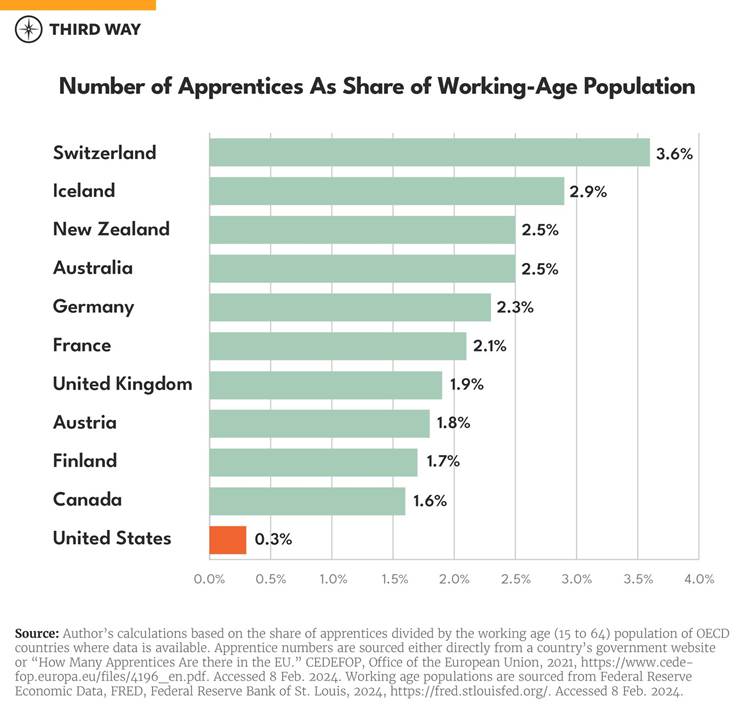
Source: Third Way: Curran McSwigan
How can the U.S. increase the number of registered apprenticeships?
Over the years, apprenticeship programs have maintained significant bipartisan support in Congress. Over the past decade, multiple presidential administrations have expressed support for apprenticeship programs and committed to expanding them. This longstanding commitment to apprenticeships is intended to expand choices for young and mid-career workers, gaining valuable on-the-job training while earning a salary, representing an alternative to higher education, which has experienced growing costs in recent years. At the same time, apprenticeship programs provide benefits to employers, addressing workforce concerns by answering the growing demand from businesses for skilled labor, including immigrant workers.
While congressional funding for apprenticeship programs has risen over the past decade, policymakers should take additional steps to expand apprenticeship programs and participation in them.
Promoting apprenticeship programs as an alternative pathway for young workers
Increasing public awareness of apprenticeship pathways for young workers takes on additional importance as a growing number of young people have sought out alternatives to college. Given significant increases in higher education costs, and trends away from a degree focused workforce to a skills focused workforce, a growing number of young workers are seeking non-college pathways in pursuit of well-paying jobs. Accordingly, promoting apprenticeship programs as an alternative pathway can help these individuals secure fulfilling and rewarding careers.
With other OECD countries successfully adopting apprenticeship programs in their workforces, the U.S. has an opportunity to similarly support and promote registered apprenticeships for its workforce. There are encouraging opportunities and growing interests to utilize these programs for a larger segment of the U.S. workforce –citizens and immigrants alike – especially for those seeking alternatives to pursuing a college degree.
Encouraging employer participation in apprenticeship programs
The federal government should take steps to encourage employer participation in apprenticeships. Because the demand for apprenticeships often outweighs available slots, increased uptake from employers is critical in expanding the use of apprenticeships.
Currently, the cost and complexity businesses must navigate in order to set up apprenticeships discourages many from participating in these programs. Incentivizing participation by employers through expanding public engagement, streamlining processes for participating businesses, offering targeted tax benefits, or encouraging the use of apprenticeships by federal contractors can help encourage better participation from employers.
In addition to increasing general awareness of the programs, better public outreach to employers could be achieved by highlighting the fact that the vast majority of apprentices (over 90%) stay with their employer nine months or longer, and that apprenticeships generate a return on investment for the cost associated with participating in apprenticeships. Drawing attention to the positive experiences from both domestic and international employers can also yield benefits. For example, large international corporations based in Germany have extensive expertise and experience with these types of programs and are putting them to use in the U.S.
Streamlining the process for participating in apprenticeships would be very beneficial in encouraging the use of these programs. Getting federal and/or state approval and completing the paperwork can be costly, challenging, and cumbersome. It is therefore understandable that larger organizations are more likely to offer apprenticeships than smaller organization (organizations with fewer than 500 employees). Appealing to smaller companies through streamlined processes has great potential to boost economic growth and opportunities, as studies have shown that smaller organizations who have offered apprenticeships have a greater return on investment than larger organizations.
Whether through promoting the benefits of apprenticeships or removing unnecessary administrative burdens from registered apprenticeships, federal agencies can take steps to make these programs user-friendly for employers while maintaining basic safeguards, including utilizing electronic record-keeping and processing, avoiding duplicative data collection, and expanding the use of intermediaries that help both apprentices and businesses manage the application process.
Tax incentives also can encourage employers to participate in apprenticeship programs. Businesses that hire qualified apprenticeships may be eligible for The Federal Work Opportunity Tax Credit (WOTC), as well as other federal and state tax incentives.
Finally, additional DOL support for intermediaries that work with perspective apprentices and businesses can be helpful to both. “Registered Apprenticeship Industry Intermediaries” help businesses work through the application process for registered apprenticeships and apprentices through the apprenticeships process, and further support for these efforts could yield positive results. Given the changing workforce and growing needs in key sectors, now is an opportune time to advance apprenticeship programs. By providing adequate funding and support for the programs, as well as taking steps to encourage better participation from both workers and employers, policymakers can offer new options to fill workforce gaps and provide alternative pathways for young and mid-career workers. The U.S. should strive to be a world leader in apprenticeships to advance training and workforce development, benefiting employers and workers, immigrants and native-born alike.