


This resource was updated on December 4, 2025.
Who is a refugee?
A person outside the U.S. seeking refuge. Based on international law, the U.S. defines a “refugee” as a person outside the country of his or her nationality, who is unable or unwilling to return to that country because of persecution or a well-founded fear of persecution based on his or her race, religion, nationality, membership in a particular social group, or political opinion.
The legal basis for humanitarian admissions of refugees and asylum seekers to the United States began with the Refugee Act of 1980, which defined a refugee, established the Reception and Placement (R&P) program for initial resettlement under the Department of State, and created the Office of Refugee Resettlement (ORR) under the Department of Health and Human Services (HHS).
Who determines the number of refugee admissions each year?
The President of the United States after consulting with Congress. The number of refugees accepted to the United States each year is set by the president in consultation with Congress. Congressional Democrats have asserted that President Trump, did not consult with Congress prior to issuing a Presidential Determination (PD) for fiscal year (FY) 2026, in violation of legal requirements requiring a consultation.
Has refugee resettlement continued in 2025 under the Trump administration?
It has largely been halted. On January 20, 2025 President Trump signed an executive order (EO), “Realigning the United States Refugee Program,” which suspended the U.S. Refugee Admissions Program (USRAP) and asserted that the entry of new refugees would be “detrimental to the interests of the United States.” The final decision to resume the program rests with President Trump, based on reviewing the required reports from the DHS Secretary, in consultation with the Secretary of State. As of early December 2025, long after they were due, no such reports have been made public and there has been no official resumption of the refugee program. An exception, however, was made to resettle around 400 white South Africans (also known as Afrikaners) in FY2025. The White House has indicated that additional Afrikaners will be resettled as refugees in FY2026.
What is the refugee target for fiscal year 2026?
7,500. The “Presidential Determination on Refugee Admissions for Fiscal Year 2026” was published in the Federal Register on October 31, 2025. The FY2026 PD was unique in many ways. It was officially signed on September 30, 2025, by the President, but not published until several weeks later. The refugee ceiling was set at 7,500, the lowest in the history of the post-1980 U.S. refugee program. Afrikaners are the only population specifically mentioned as the primary group included in the 7,500-refugee ceiling. The PD does mention “other victims of illegal or unjust discrimination in their respective homelands” as populations of interest but does not specify countries of origin for those populations.
After congressional Democrats complained that the Administration never consulted with Congress, on November 20 – nearly two months into the new fiscal year –the administration finally conducted a consultation with Congress but did not send any Cabinet-level participants, contrary to existing legal requirements.
Consistent with language in the January 20, 20-25 executive order, the PD asserts that the determination is “justified by humanitarian concerns or is otherwise in the national interest.” The first FY2026 Afrikaner arrivals were admitted into the U.S. during the last week of November 2025.
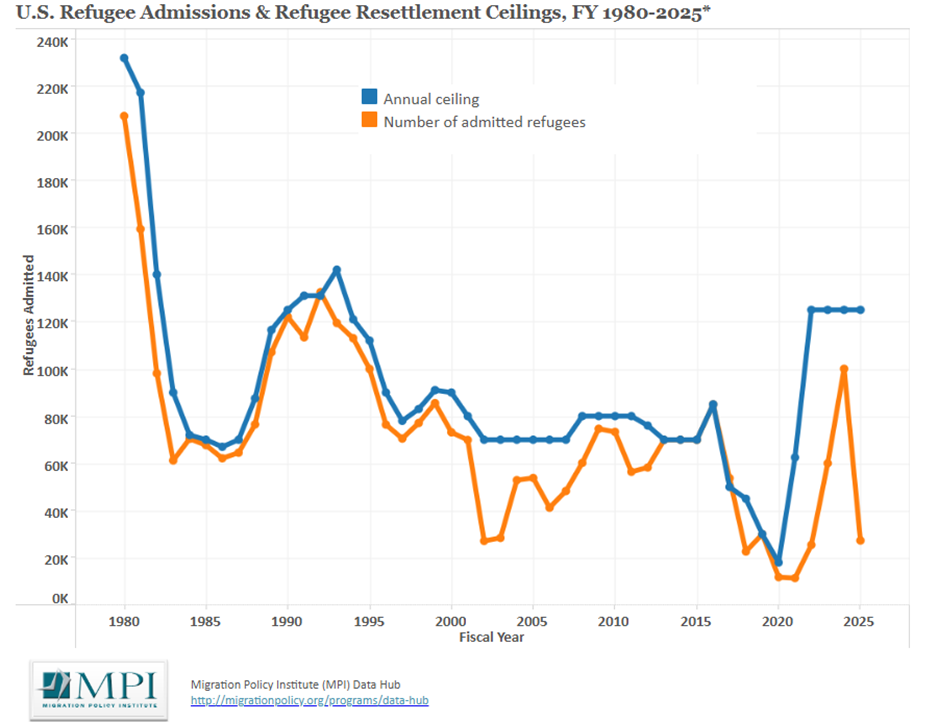
Source: Migration Policy Institute (MPI) analysis of WRAPS data from the State Department Bureau of Population, Refugees, and Migration. Available at www.wrapsnet.org/admissions-and-arrivals/
Where do refugees come from?
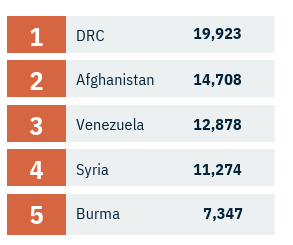
All around the world. The United States admits refugees from more than 60 countries all around the globe. In FY2024, the most recent full fiscal year of refugee resettlement, U.S. refugees came mainly from Democratic Republic of Congo, Afghanistan, Venezuela, Syria, and Burma. Refugees arrived and were resettled for one quarter and part of January of FY2025, but the program was suspended following the president’s January 2025 executive order. The primary population of refugees that entered under the Trump administration in FY2025 were Afrikaners.
Top 5 Countries of Origin in FY2024
Source: RCUSA
Where do refugees resettle in the U.S.?
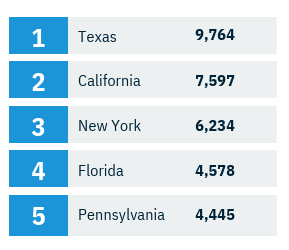
All across the United States. Refugees have been resettled in 49 U.S. states, with Texas, California and New York resettling the most refugees in FY 2024.
Top 5 States Welcoming Refugees in FY2024
Source: RCUSA
Who refers refugees to the U.S. for resettlement?
Historically, the United Nations High Commissioner for Refugees (UNHCR) primarily referred refugees to the U.S. UNHCR, the United Nations (UN) Refugee Agency, is an international agency dedicated to protecting forcibly displaced communities and stateless people. UNHCR screens applicants to determine whether they qualify as refugees and if they are in particular need of resettlement, and, if so, refers them to the U.S. and other countries. In other cases, refugees are referred to the USRAP by a U.S. Embassy, a specially trained nongovernmental organization, sponsorship groups, and family members in the U.S. There is a separate Special Immigrant Visa (SIV) application for those who served the U.S. military/government in Iraq and Afghanistan.
Upon taking office in 2025, the Trump administration has acted outside the existing UNHCR framework to resettle Afrikaners as refugees. Notably, UNHCR has not designated Afrikaners as a group warranting refugee status and has not been involved in determining their refugee status or vetting them for U.S. resettlement.
How long does it take to screen and vet a refugee?
On average, nearly two to three years. Prior to this administration’s refugee resettlement halt, the time to vet and resettle a refugee – from the refugee’s initial UNHCR referral to his or her arrival in the U.S. – averaged approximately 18 to 36 months. Of course, total processing time varied depending on an applicant’s location as well as other circumstances and policy changes. Afrikaner resettlement under the Trump administration has proceeded on a much faster timeframe of a few months, as it does not go through existing UNHCR channels, as noted above.
To be admitted to the U.S., refugees historically have gone through several rounds of background checks, screenings and interviews under the United States Refugee Admissions Program (USRAP), including:
- After an initial screening by UNHCR, the Resettlement Support Centers (RSCs) located around the world collect applicants’ biographic and other information.
- After the State Department preliminarily approves an application to begin the resettlement process, they are reviewed by officers from U.S. Citizenship and Immigration Services (USCIS) in the Department of Homeland Security (DHS), as well as ongoing vetting by a variety of intelligence agencies including the FBI, CIA, and others.
- USCIS also conducts an in-person interview with each refugee applicant before deciding whether to approve him or her for resettlement in the U.S.
- All USCIS-approved refugees then undergo health screening to prevent those with contagious diseases from entering the U.S.
- Most refugees undergo a cultural orientation course prior to their arrival.
- Before refugees arrive, it is established where in the United States they will initially live and which refugee resettlement agency will help orient them to life in the United States.
- After arrival to the U.S., all refugees are checked at the airport by a U.S. Customs and Border Protection (CBP) officer to ensure they are the same people that were screened and approved for admission.
What do refugee resettlement agencies do?
Assist refugees after their arrival in the U.S. After the final screenings by the U.S. government, the refugees are picked up at the airport by a representative of one of the ten domestic resettlement agencies, all of which have cooperative agreements with the U.S. Department of State (DOS).
Shortly before the arrival of the refugees, the resettlement agencies arrange for their housing, which include basic furnishings, appliances, climate-appropriate clothing, and some of the food typical of the refugees’ culture. When the refugees arrive, the representatives take refugees to their new homes.
After arrival, the agencies help refugees to start their lives in the U.S., assisting them with applying for a Social Security card, registering children in school, learning how to access shopping facilities, arranging medical appointments, and connecting them with needed social or language services.
Of course, the January 2025 executive order indefinitely suspending USRAP, has halted resettlement and was followed by additional changes. Two resettlement agencies the U.S. Conference of Catholic Bishops (USCCB) and the Episcopal Migration Ministries (EMM) left the resettlement space, and the Biden-era private resettlement initiative – the Welcome Corps, which also carried out many of these functions – was terminated.
How is refugee resettlement funded?
Through the Department of State and the Department of Health and Human Services. The State Department funds the International Organization for Migration (IOM) to provide refugees with an interest-free loan to travel to the U.S., which they are required to start repaying sometime after they arrive. The State Department’s Reception and Placement (R&P) or the initial resettlement program, supplies resettlement agencies a one-time per refugee sum, to finance their first 30-90 days in the U.S. That money goes mostly towards rent, furnishings, food, and clothing, as well as the cost of the agency’s staff for administrative, case management, and other integration services.
On October 31, 2025, the initial resettlement program was transferred over to Office of Refugee Resettlement (ORR) through an executive action entitled “Presidential Determination on Transferring the United States Program of Initial Refugee Resettlement.”
Historically, during and after the initial three months, HHS’s Office of Refugee Resettlement worked through the states and other nongovernmental organizations to provide refugees with limited cash and medical assistance, as well as short-term language, employment, and social services, and longer term integration services all of which represents the majority of funding made available to refugees resettled in the U.S. The currently arriving Afrikaners are eligible for ORR benefits as they are entering the U.S. with refugee status.
Can refugees legally work in the United States?
Yes. Upon arrival in the U.S., refugees receive employment authorization and are encouraged to become employed as soon as possible so that they can support themselves.
Can a refugee become a U.S. citizen?
Yes. All refugees are required to apply for a green card to become a permanent resident after one year in the United States. After five years of residency, they are eligible to apply for U.S. citizenship.
Are all recent refugee cases being reopened and reconsidered?
Yes. On November 21, 2025, an internal USCIS memo – “Review of Certain Refugees Admitted to the United States and an Immediate Hold on Certain Refugees with a Pending I-485, Application to Register Permanent Residence or Adjust Status” provided for the review of more than 200,000 lawfully admitted refugees who entered the U.S. between January 20, 2021, and February 20, 2025, and a halt to all processing of green card applications for refugees who entered during this time period. The memo, in an unprecedented move, directs USCIS to reopen and review thousands of cases of those admitted in that four-year span, potentially terminating the refugee status of already-admitted refugees who USCIS subsequently determines have not met refugee criteria, as well as preventing this cohort from obtaining green cards and eventual citizenship until this review process is complete. Depending on the outcome of the re-interview process, their green card application could be denied or their green card revoked.