

Introduction
U.S. Customs and Border Protection (CBP) is responsible for securing U.S. borders between and at ports of entry. CBP comprises about 60,000 employees, making it the largest law enforcement agency in the country. The U.S. Border Patrol – one of CBP’s two components [1] – was established in 1924 to secure the border between ports of entry (back then called “inspection stations”). In 1925, the Border Patrol’s duties were expanded to include the seacoast.
The Border Patrol is an agency with unique law enforcement authorities. Within 100 miles of any land border or U.S. coastline, the Border Patrol operates with an expanded authority that other law enforcement agencies do not have. Border Patrol agents can operate immigration checkpoints and board buses or trains for immigration inquiries. The Border Patrol also operates outside the 100-mile border zone, but in those cases it must follow the same constitutional limits as any other law enforcement agency. The Border Patrol’s authority, thereby, is divided into the 100-mile border zone and outside the 100-mile border zone.
Hundred-Mile Border Zone
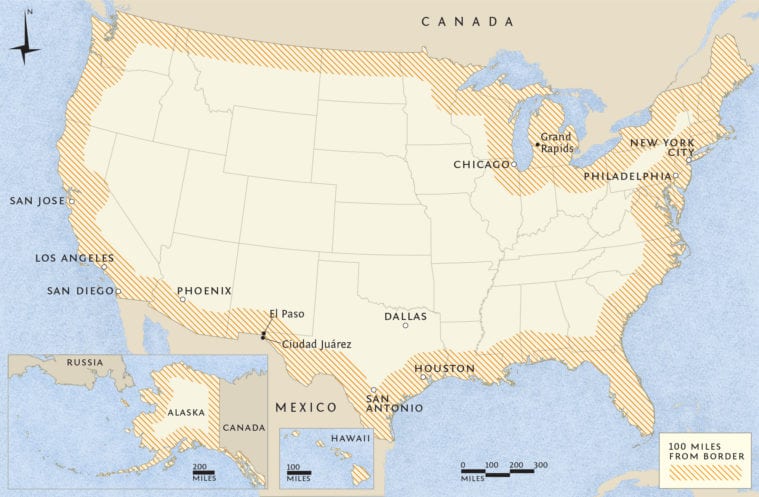
Federal law allows immigration officers to conduct certain kinds of warrantless stops and searches within 100 miles from U.S. borders. This provision, set under the Immigration and Nationality Act (INA) of 1952, provides broad authority to U.S. Customs and Border Protection (CBP) agents and officers. The 100-mile zone includes land borders and the entire U.S. coastline, including major cities like New York, Los Angeles, and Chicago. However, this special authority is not absolute. Important limits, including Fourth Amendment protections, still apply.
Federal law states that an authorized immigration officer “within a reasonable distance from any external boundary of the United States” is allowed to “board and search” any vessel in territorial waters and any vehicles, trains, conveyances, or aircraft to search for undocumented immigrants. Under federal regulations, “external boundary” and “reasonable distance” are defined as follows:
- External Boundary: The term “external boundary” is defined as “the land boundaries and the territorial sea of the United States.”
- Reasonable Distance: The term “reasonable distance” is defined as “100 air miles from any external boundary of the United States.”
The term “external boundary” covers U.S. land borders and the coastline, including the Great Lakes. Nearly 213 million people (two-thirds of the U.S. population) reside within the 100-mile zone. The zone includes the major metropolitan areas mentioned above (New York, Los Angeles, Chicago) and entire states, like Florida and Michigan.
100-Mile Border Zone Authority [2]
Federal law also permits immigration officers to access private lands – within 25 miles from an external boundary – for the purpose of patrolling the border. However, immigration officers cannot enter a person’s home within this 25-mile zone without a warrant. The law explicitly states that dwellings are excluded from this authority.
As a result, within the 100-mile border zone, Border Patrol agents can take the following actions without a warrant:
- Board and search vessels in territorial waters;
- Board and search vehicles, trains, conveyances, or aircraft; and,
- Enter private lands – but not dwellings – within 25 miles from an external boundary.
The Border Patrol utilizes these authorities to conduct warrantless searches within the 100-mile border zone. The Border Patrol’s enforcement efforts within the 100-mile border zone include immigration checkpoints on public highways. These checkpoints are used to stop vehicles for brief questioning about the passenger’s immigration status. Another major component includes Border Patrol agents boarding buses and trains as part of their immigration enforcement efforts to ask passengers questions about their immigration status. The boarding usually happens near the southern border, either at the station or while the bus is on its journey. The agents’ questions are generally brief and related to verifying passengers’ immigration statuses.
Border Patrol Checkpoints
The Border Patrol operates immigration checkpoints within the 100-mile border zone to intercept individuals without documentation, illicit substances and other contraband. Most checkpoints are concentrated along the southern border in the states of Arizona, California, New Mexico, and Texas. The checkpoints are typically located 25 to 75 miles from the border, although they can operate up to 100 miles in the interior. The Border Patrol apprehended 35,700 removable individuals in about 17,500 encounters at checkpoints from fiscal year (FY) 2016 through FY 2020, which represented about two percent of all Border Patrol apprehensions during that period. There are two types of checkpoints:
- Permanent. These checkpoints have “permanent” brick and mortar structures and infrastructure, including off-highway covered lanes for vehicle inspection, buildings for administration and detention of persons.
Tactical. These checkpoints usually do not have “permanent” infrastructure in place and typically are comprised of a few Border Patrol vehicles, orange cones to slow down and direct traffic, portable facilities, and warning signs to notify vehicles about the checkpoint. [3]
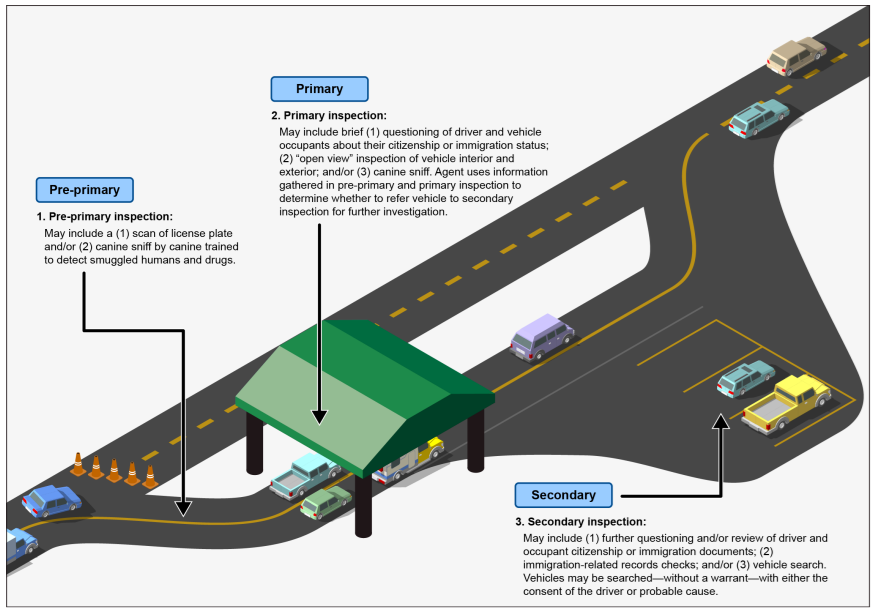
At the checkpoint, Border Patrol agents are allowed to question vehicle occupants about their citizenship and request document proof of their immigration status. Border Patrol agents also make quick observations of what is in plain view inside the vehicle. Agents can refer motorists to secondary inspection for further questioning and review. The checkpoints are governed by an intricate set of guidelines that aim to balance governmental interests in stopping illegal immigration and Fourth Amendment protections against unreasonable search and seizure.
Two major court decisions govern the Border Patrol’s authority to operate checkpoints within the 100-mile border zone. In United States v. Martinez Fuerte (1976), the U.S. Supreme Court held that the Border Patrol’s routine stopping of vehicles at a reasonably located, permanent checkpoint is consistent with the Fourth Amendment. The court ruled that “[w]hile the need to make routine checkpoint stops is great, the consequent intrusion on Fourth Amendment interests is quite limited.” The court found that only minimal intrusion exists for motorists stopped at permanent checkpoints, even in the absence of reasonable or individualized suspicion to make those stops. In United States v. Gordo Marin (1980), the U.S. District Court for the Southern District of Florida found that there is no “constitutional distinction” between either “permanent” or “temporary” checkpoints.
Border Patrol Checkpoint Process [4]
Limitations
There are important constitutional protections that limit Border Patrol activities within the 100-mile border zone, including onboard buses and trains and at checkpoints.
Passengers onboard a bus or train who are questioned by Border Patrol agents are not required to answer the agent’s questions. Passengers have the right to remain silent or indicate they wish to refrain from answering the questions. That said, refusing to answer a Border Patrol agent’s question could result in further questioning and/or being detained. If a Border Patrol agent detains an individual, they must have reasonable suspicion that the individual committed an immigration violation. The longer the individual is detained – particularly as the detention goes from brief to prolonged – the more suspicion an agent is required to have to keep the individual detained.
Border Patrol agents may stop a vehicle for brief questioning about the occupant’s citizenship status at a checkpoint without reasonable suspicion that any crime has been committed, but agents are required to have either that individual’s consent or probable cause to conduct a full search of a vehicle. As a standard, probable cause demands a higher degree of certainty and probability than reasonable suspicion. Probable cause is a requirement under the Fourth Amendment that must typically be satisfied before law enforcement conducts a search, makes an arrest, or obtains a warrant.
The Legal Information Institute at Cornell Law School defines reasonable suspicion and probable cause in the following manner:
- Reasonable suspicion exists when “an officer can point to specific, articulable facts suggesting that criminal activity may be occurring.” This permits “only brief, limited investigative stops and pat-downs.”
- Probable cause exists when “the facts and circumstances within an officer’s knowledge would lead a reasonable person to believe that a crime has been committed (for an arrest) or that evidence of a crime is present in a specific location (for a search).” [5]
The Border Patrol is not required to meet the reasonable suspicion standard when stopping a vehicle at a permanent checkpoint, but must meet the probable cause standard to conduct a full search of the vehicle. According to CBP, probable cause at checkpoints can be developed from, “agent observations, records checks, non-intrusive canine sniffs, and other established means.”’
The Border Patrol also conducts roving patrols. In these enforcement activities, Border Patrol agents pull motorists over to question them about their immigration status. For these operations, Border patrol agents must have reasonable suspicion that the driver or passengers in the car committed an immigration violation or federal crime. Any arrest or prolonged stop requires probable cause.
Outside the 100-Mile Border Zone
The U.S. Border Patrol, as a law enforcement agency, is allowed to operate outside the 100-mile border zone. In such places, the special authority provided to the Border Patrol within the 100-mile border zone does not apply. The Border Patrol must follow the same constitutional limits as any other law enforcement agency. Namely, enforcement activities must meet the following requirements:
- Border Patrol agents must have reasonable suspicion to stop and question individuals about their immigration status – hence the Border Patrol cannot onboard buses or trains and/or operate checkpoints.
- Border Patrol agents must have probable cause to detain individuals for a prolonged period or to arrest them.
- Border Patrol agents can arrest any individuals (including U.S. citizens or residents) who commit federal crimes in their presence.
The key takeaway is that the Border Patrol cannot operate immigration checkpoints or board buses and trains outside the 100-mile border zone. While there are more limits to the Border Patrol’s authority outside the so-called border zone, it is important to note that only one-third of the U.S. population reside outside 100 miles from the country’s borders and coastline. Most Border Patrol enforcement activities have historically occurred within the 100-mile border zone, particularly the 100-mile zone from the U.S.-Mexico border and, to a lesser extent, the northern border. Recent operations in Los Angeles and Chicago, however, have expanded the Border Patrol’s presence within the 100-mile border zone from U.S. coastlines. And, some operations have even expanded the Border Patrol’s presence outside the 100-mile border zone.
The Trump administration initiated a Border Patrol operation, named “Charlotte’s Web,” in Charlotte, North Carolina in November 2025. The operation was notable because the city is 150 miles from the nearest coastal border and 1,200 miles from the U.S.-Mexico border. Border Patrol agents arrested more than 130 individuals as part of the operation in just two days. While it was legally permissible for Border Patrol personnel to take part in this operation, because they were outside the 100-mile zone, they did not have enhanced stop and search authority and were restricted in terms of their ability to set up checkpoints or board trains and buses.
Nationwide Immigration Stops
The U.S. Border Patrol has law enforcement authority that the agency can use both inside and outside the 100-mile border zone. Notably, Border Patrol agents can question people that they believe may be an immigrant or arrest an individual without a warrant if they believe the individual is breaking immigration law and likely to flee before a warrant can be obtained. These powers are ostensibly constrained by the Fourth Amendment’s reasonable suspicion and probable cause requirements, but the way they are implemented provides Border Patrol agents with significant authority.
One key question is what factors Border Patrol agents can rely on to meet the reasonable suspicion and probable cause requirements. Recent legal developments have provided them with expansive authority in this area. The U.S. Supreme Court on September 8, 2025 lifted a lower court’s order that prohibited immigration agents from considering certain factors when deciding to stop and question people about possible immigration law violations. In Noem v. Vasquez Perdomo, U.S District Judge Maame Ewusi-Mensah Frimpong ruled that immigration agents cannot stop people in Los Angeles and the surrounding counties based on their “apparent race or ethnicity,” “[s]peaking Spanish or English with an accent,” “presence at a particular locations,” and “the type of work one does.” The Ninth Circuit upheld Frimpong’s decision, but the Supreme Court, utilizing its emergency docket, blocked the decision on appeal in a four-sentence unsigned decision without explaining its reasoning.
While the majority decision in Noem v. Vasquez Perdomo did not provide its rationale in reaching its decision, Supreme Court Justice Brett Kavanaugh issued a concurrence providing his legal reasoning. Kavanaugh’s concurrence argues the Fourth Amendment provides law enforcement officers the flexibility to consider “any number of factors” when meeting the reasonable suspicion and probable cause requirements. The concurrence reasons that immigration agents could consider the “high number and percentage” of migrants living in Los Angeles and the surrounding counties who were likely in violation of immigration law, where they gather, the kinds of jobs they pursue, their lack of English language acquisition, and their “apparent ethnicity.” Per Kavanaugh, it is constitutionally permissible and “common sense” that these factors “constitute at least reasonable suspicion of illegal presence in the United States.” Subsequently, some critics of the approach, who have expressed concerns that it will inevitably lead to racial profiling, unlawful detentions and the violation of individual rights, have deemed such immigration encounters as “Kavanaugh stops.”
These new legal developments have provided substantial authority to Border Patrol agents and other immigration officers in conducting immigration-related activities nationwide. While prevented from utilizing checkpoints or boarding buses and trains outside the 100-mile border zone, Border Patrol personnel conducting operations anywhere in the U.S. are technically able to consider an individual’s apparent race and ethnicity, use of a foreign language or accented English, and his or her job in stopping and questioning the individual’s immigration status. Such broad authority provides Border Patrol agents a high level of discretion and power across the U.S. to meet reasonable suspicion standards to stop and question people, both inside and outside the 100-mile border zone.
[1] U.S. Customs and Border Protection (CBP) is the parent agency of both the U.S. Border Patrol, responsible for securing the border between Ports of Entry (POEs) and whose law enforcement personnel are often referred to as “agents,” and the Office of Field Operations (OFO), responsible for securing the border at POEs and whose law enforcement personnel are often referred to as “officers.” Congress created the Department of Homeland Security (DHS), including CBP as one of its components, in 2002. The Border Patrol, which has been in existence since 1924, was folded into CBP. DHS officially began operations on March 1, 2003.
[2] Illustration by Dolly Holmes. Source : Melissa Del Bosque, “Checkpoint Nation,” Texas Observer (October 8, 2018) https://www.texasobserver.org/checkpoint-nation/.
[3] The Border Patrol operated 66 checkpoints in all five years from FYs 2016 through 2020. Of those, 35 were permanent and 31 were tactical.
[4] Source: “Border Patrol: Actions Needed to Improve Oversight and Data,” United States Government Accountability Office (June 2022): https://www.gao.gov/assets/gao-22-104568.pdf.
[5] Immigration offenses are civil offenses, not criminal. That said, the same legal standard of proof should generally apply.