


Conference committees are a mechanism used by Congress to reconcile differences between legislation that has been passed in each respective chamber. Identical legislation must be agreed upon by the Senate and the House in order to become a law, according to the U.S. Constitution.
Where the two houses need to reconcile two versions of a bill, a temporary committee is tasked with negotiating a proposal to be passed by both chambers without amendments. Typically, differences arise when a bill originates in the House—and includes tax or appropriations measures —and is then significantly amended by the Senate and sent back to the House.
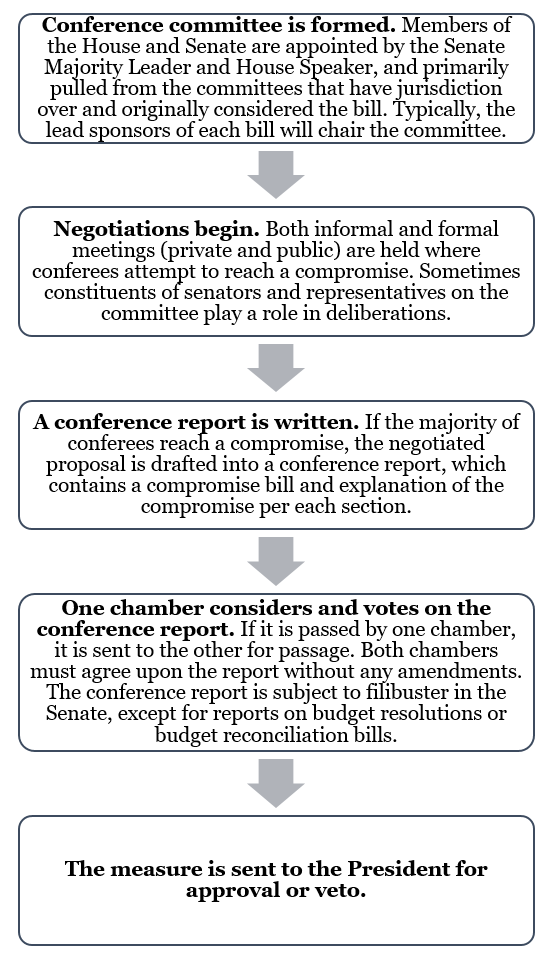
When the House and Senate agree to form a conference committee to resolve differences in legislation, the process is as follows:
The National Immigration Forum would like to thank Rachel Shaheen, policy intern, for her extensive contributions to this explainer.